
Long and cold winters force Canadians to keep their windows closed and doors tightly sealed, while heating systems run at full capacity during the colder months. That may sound good and energy-efficient, but there is a hidden danger: indoor radon levels can accumulate to dangerously high levels and become a hidden health risk.This stack effect creates high negative pressure, pulling radon up through the foundation. That is why radon has been a silent danger and is the second leading cause of lung cancer in Canada, after smoking.

Winter season – the best time to do a long term radon test
Understanding this winter dynamic is crucial for homeowners. Radon testing and mitigation are most effective when done during the winter season when levels are likely to be at their highest.
This can lead to the most accurate “worst-case scenario” data required by Health Canada guidelines.
Canada is a country where radon is a significant concern, particularly in certain regions. And two houses next to each other can have very different radon levels — the only reliable way to know is to test.
A recent Canadian survey shows that approximately 1 in 5 Canadian homes (17.8%) have radon levels at or above 200 Bq/m³.
The” stack effect” – How heating your home can draw radon indoors
The stack effect is a natural process where warm indoor air rises and escapes from higher points in a home, such as the attic. It creates a vacuum that draws in air from the ground and harmful gases—from below.
Here is how it works during cold weather:
- Warm air rises: Heated air inside the house moves upward and escapes through the upper parts of the home. It can leak out through the attic, roof, vents, chimneys, and small gaps around windows or other openings.
- Vacuum creates: This rising air creates negative pressure (a vacuum) in the basement and lower levels in the building. Cold outdoor air is pulled into the lower parts of the house.This cold air can enter through cracks in the foundation, floors, walls, and around pipes or drains.
- Radon enters: The negative pressure created by the stack effect can draw radon-containing soil gas into the basement or cracks in the foundation. Radon is produced naturally in soil and rock beneath and around a building.
This is one reason that basements and lower levels can have higher radon levels, especially in tightly sealed homes during winter.
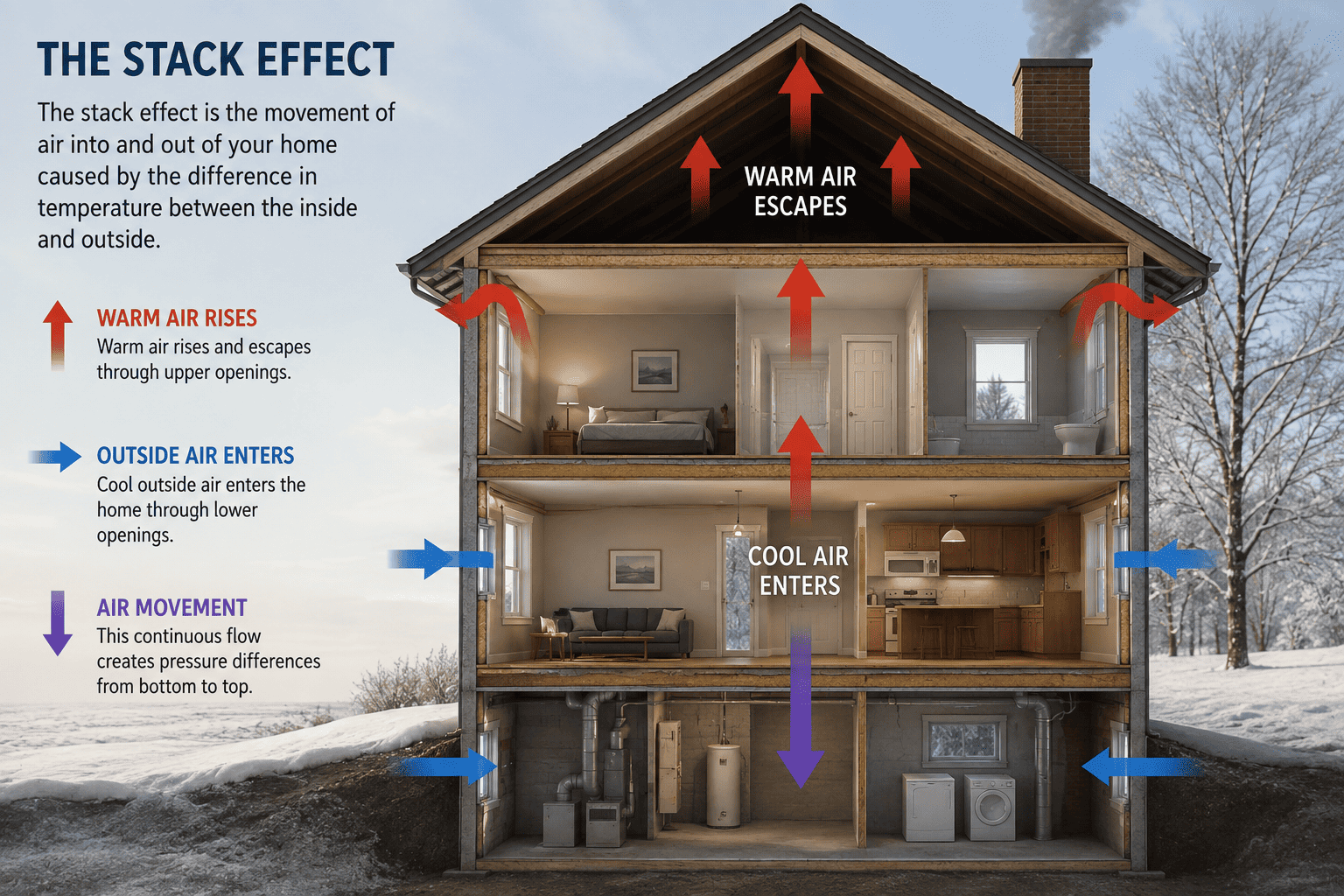
Why radon levels changes during the heating season
There are several reasons for this problem. The long and freezing winters make Canadians seal their homes. When windows and doors stay closed it turns off natural ventilation and traps the gas inside. Another important issue is the big difference between freezing Canadian outdoor temperatures and indoor heating that intensifies the upward airflow. This creates extreme temperature gaps. Another important aspect is that snow and frozen ground can force radon gas to find the way to your basement.
How to know if your home is at risk!
Radon is completely invisible, tasteless and odorless. This makes it possible for two identical houses next door to each other to have completely different radon levels, depending on the ground and the soil composition.
The only definitive way to know if you are at risk of radon is to run a certified long-term-test during the peak winter months.
Read more about how to measure radon here
Winter season- the right time to start the long term-test
Health Canada recommends a long-term test of at least 91 days to get an accurate measurement of your average annual exposure, conducted primarily during the heating season between October and April.This captures the period when the winter stack effect is strongest and indoor radon levels peak.
A summer radon test can tell only part of the story
Studies show that testing your home in the summer often underestimates your true annual average. A home that shows a safe result in July can easily jump well past the Canadian safety action levels of 200 Bq/m³ by January. Testing during the heating season ensures you are testing your home when your family’s indoor time and the home’s radon levels are both at their highest.
What “long-term radon testing” means in Canada
Here are some facts:
- Minimum: 91 days
- Recommended duration: 3–12 months
- Best timing: Ensure at least 91 days fall within the heating season
- Testing location: Lowest lived-in level of the home
- Comparison level: Canada’s radon guideline is 200 Bq/m³ for the average annual radon concentration.
How to test your home during the Canadian heating season
Make sure you start your Radon test before the winter is over. A longer test, typically three to twelve months ensures a better representation of the home’s average radon level over time. Health Canada recommends a long-term radon measurement lasting at least 91 days, with at least 91 of those days taking place during the heating season.
This is how you do:
Place the detector on the lowest level of your home that is regularly occupied, such as a basement, family room, or bedroom. Keep it away from windows, doors, vents, exterior walls, and direct sources of heat, and leave it undisturbed for the recommended duration of the test.
Starting your test early in the heating season can help ensure that enough of the measurement period falls within the colder months. Once the test is complete, the results can help determine whether further action or radon mitigation should be considered.
The goal isn’t simply to measure radon in winter—it’s to capture enough seasonal variation to understand your home’s typical radon exposure especially during the heating season.
High radon levels are manageable
Understanding the regional variations and the higher risks during winter, especially the heating season. It’s important to stay proactive and do radon testing before the winter and implement mitigation strategies when needed. This makes it possible to reduce exposure to this dangerous gas.
For more information on radon testing or if you have any concerns about radon in your home.Our knowledgeable technicians are more than happy to help you!
Contact us here!